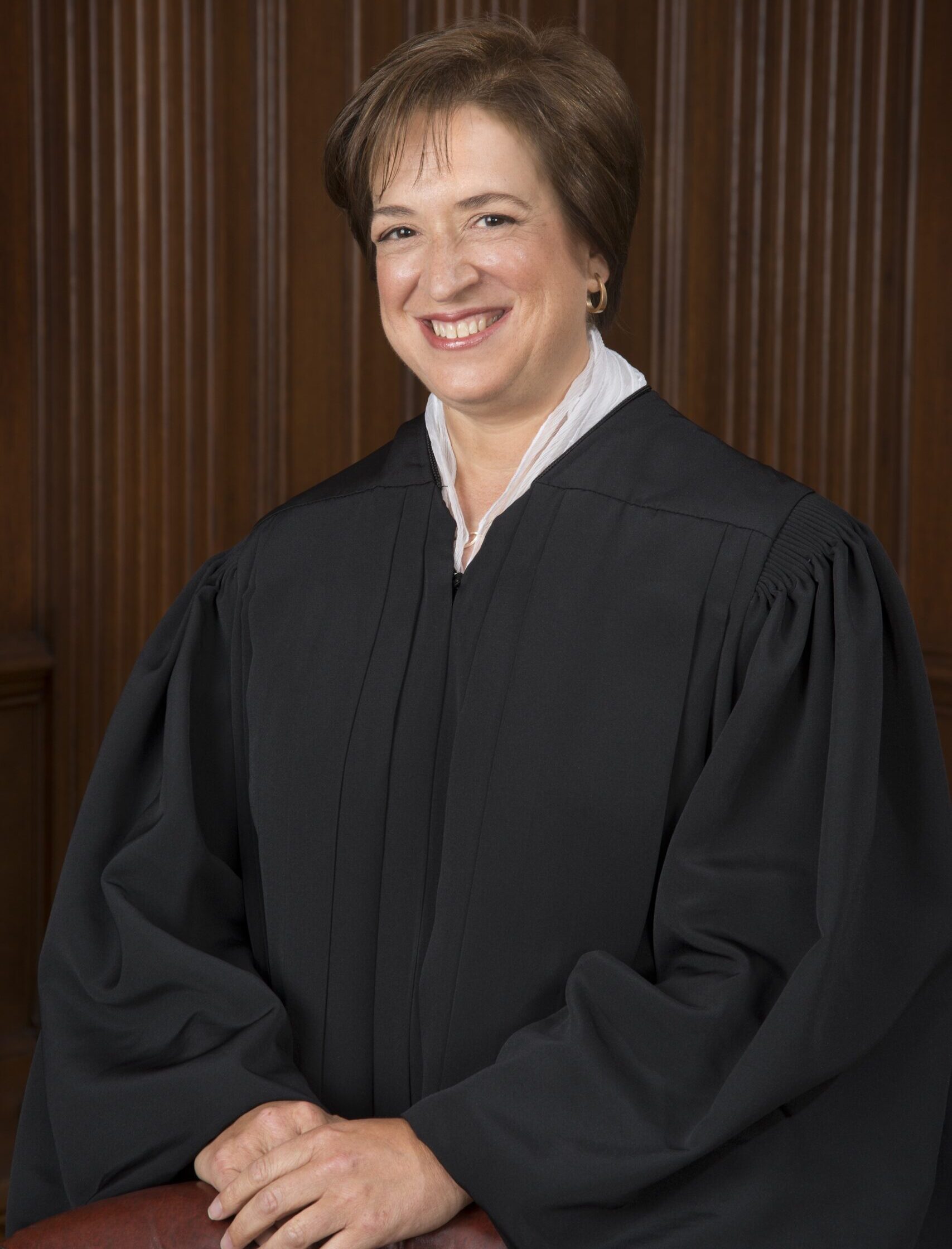
The Supreme Court of the United States is the only court that receives its power directly from the U.S. Constitution. Article III provides that “the judicial power of the United States shall be vested in one Supreme Court, and in such inferior Courts as the Congress may from time to time ordain and establish.” The Court checks the power of the political branches of government, established by Articles I and II of the Constitution. It often does this by striking down laws or regulations that are incompatible with the founding document. However, the Court also must not reach beyond its own sphere of power and interfere with the other branches.
A Chief Justice has always presided over the Court, but the number of Associate Justices has fluctuated. Since 1869, though, the Court has consisted of eight Associate Justices, in addition to the Chief Justice. In the 1930s, President Franklin D. Roosevelt proposed expanding the Court, but this initiative failed and has not been revisited.
The Court meets in the Supreme Court Building in Washington, D.C., which was completed in 1935. Before that date, the Court met in various chambers of the U.S. Capitol Building for most of its history. During its first decade, it met in New York City and Philadelphia, each of which briefly served as the national capital before Washington, D.C. was founded. Each term of the Court starts on the first Monday in October, and its recess begins in late June or occasionally in early July.
Eras of Supreme Court history are generally defined by Chief Justices. Current Chief Justice John Roberts, whose tenure started in 2005, is the 17th Chief Justice. The first Chief Justice was John Jay, who served from 1789 to 1795. The longest-serving Chief Justice was John Marshall, whose tenure extended from 1801 to 1835. Click on an era of the Court below to learn more about its history.